On the ride into the city it was clear that this place was different.
Yes there was the sunshine, the blue sky, the palm trees, the sparkling Mediterranean, but this was no longer the Middle East, this was the European Med.
This was now Spain, or more specifically
Barcelona.
We had made the trip so the Skipper could attend the "ESMO World Congress on Gastrointestinal Cancer", and to catch up on a little R&R away from the Magic Kingdom.
Several disreputable souls from the Magic Kingdom who were sponsored by Roche Pharmaceuticals.
Barcelona is an old city, sitting on the shores of the western Mediterranean, although not as old as Beirut which we visited several weeks ago. It had its share of cultures from the Carthaginians, to the Romans, to the Moors who were eventually kicked out to make way for the present Spaniards. It was the city to which Columbus returned from his adventures "discovering" the New World when he brought back several Carib natives with him for display. Subsequent to that
Spain became a major world power exploiting many parts of the world, although the French and the British eventually put an end to that. Today we think of its sunny beaches, vineyards, bull fights, Barcelona FC football club, flamenco dancers, cafes, and night life, as well as its historical culture. Barcelona is now Spain's second major city after Madrid.
Foremost to us however it is
a Mediterranean city.
Boats on the Med (telephoto from our hotel window) - a body of water with a vast maritime history.
The Skipper & Admiral awaiting our dinner after examining the fleet. This is part of
Port Vell, an extension of the old town, clearly modern now.
The old Port Vell area has been developed for strolling with its cafes and modern marine facilities for boats clearly part of the scene.
Dining by the harbor. We elect for typical local specialties such as this Gazpacho soup, calamari, and paella to come. At other times during our visit we also ate Italian and Mexican food - remember it was the Spaniards who made Mexico part of their empire for a while. During our time here we also indulged in other liquid refreshments ranging from Sangria to Rioja.
The harbor is a beautiful area for strolling, with a mixture of traditional and modern sailing vessels.
This "classic modern" schooner sits opposite a number of larger power yachts also fairly common here.
Just up from the harbor, abutting the old town, one can see that the major road running along the sea front is dropped below ground level, allowing a more pleasant promenade with frequent walking bridges crossing over to the harborfront.
Further up the coast, going toward our hotel and conference centre, there are several
beaches. Not seen here are the many woman that remain topless on these beaches - yes this is the European Med!
Along the beach areas are many modern apartments & condos - quite expensive, even by Toronto standards. The cost of living in the Euro Zone is quite high, although a German couple we met thought it was "cheap" in Spain - maybe in the old days - I guess it's all relative.
Yes Barcelona is a city by the sea, but it is also so much more. The city has an excellent transportation system, likely modernized for the Olympic Games it hosted a few years back. However it also has an excellent bus service such as this one which is set up for tourists, who for one daily fare can go on three major routes throughout the city, getting on and off at one's leisure so as not to rush. A great way to see the city. Obviously sitting up top in the open air is the most fun.
A trip into the
old town via this bus service. This is just up from the old harbor area we visited.
The
Barcelona Cathedral. This was begun in 1298 on the foundations of a Roman temple and a Moorish Mosque. However it was not finally completed until the last century.
Part of the interior roof of the Barcelona Cathedral.
There are many narrow interesting streets for exploring the old town.
La Rambla street is one of the most famous streets for strolling in Spain. Many interesting sights.
Part of strolling along La Rambla. This is a historic avenue that runs through the old town down to the harbor. It is active day and night. There are many old buildings, cafes, bars, stores, markets, and other entertainment.
A large fruit, vegetable & other food market running off La Rambla street.
Another view of La Rambla street. Of note the large number of trees present on many of the streets, even in the old town. The locals, as well as tourists, love to get out and walk - living cities.
As noted, La Rambla eventually ends at the harbor.
Many beautiful vistas while strolling.
Off on the bus again - need to visit one of Barcelona's most famous landmarks. From an artistic point of view we have heard of Picasso (the museum here we missed) but what about Gaudi?
This is viewing the upper part of Gaudi's masterpiece, the
Sagrada Familia. It is reputed to be Europe's most unconventional Church and an emblem of Barcelona, a city that thinks of itself as individualistic. Gaudi started its development in 1883 and it is still being built, but according to his design! Gaudi is buried in the crypt. The front and back entrances of the church have quite different designs & themes. This is the front. Note the cranes for its ongoing construction. Visitors fees help pay for the construction.
Over the front entrance is the "Passion Facade", which depicts the sufferings and execution of Jesus.
The opposite entrance to the "Sagrada Familia" Church is a very different design.
The facade over this entrance is called the "Nativity Facade". The central part of the facade is pictured here. Its style is different from the "Passion Facade" at the other entrance.
Part of this facade depicting the Three Wise Men.
Part of the interior just inside the main entrance. An eclectic mix.
The stained glass windows are not what is expected of a church like this one - a modern design, rather than pictorial images.
Further images - unusual chandelier?
How about the ceiling? Vegetation in stone? Two images next to each other. Note the circular (black) stairway going up, shown in the bottom central portion of the lower image.
An alternate, more modern view of Barcelona architecture. Almost surreal in this evening light.
Opposed to the modern architecture, is what is more to be expected of an old European city.
This view is looking up at the "
Museu Nacional d'Art de Catalunya", which is not only a museum but also houses a nice restaurant (in the windows seen above) where our small group from Saudi Arabia ate dinner - a spectacular view of the city below as this sits on a hill.
The view from "
Montjuic", actually from the steps in front of the museum.
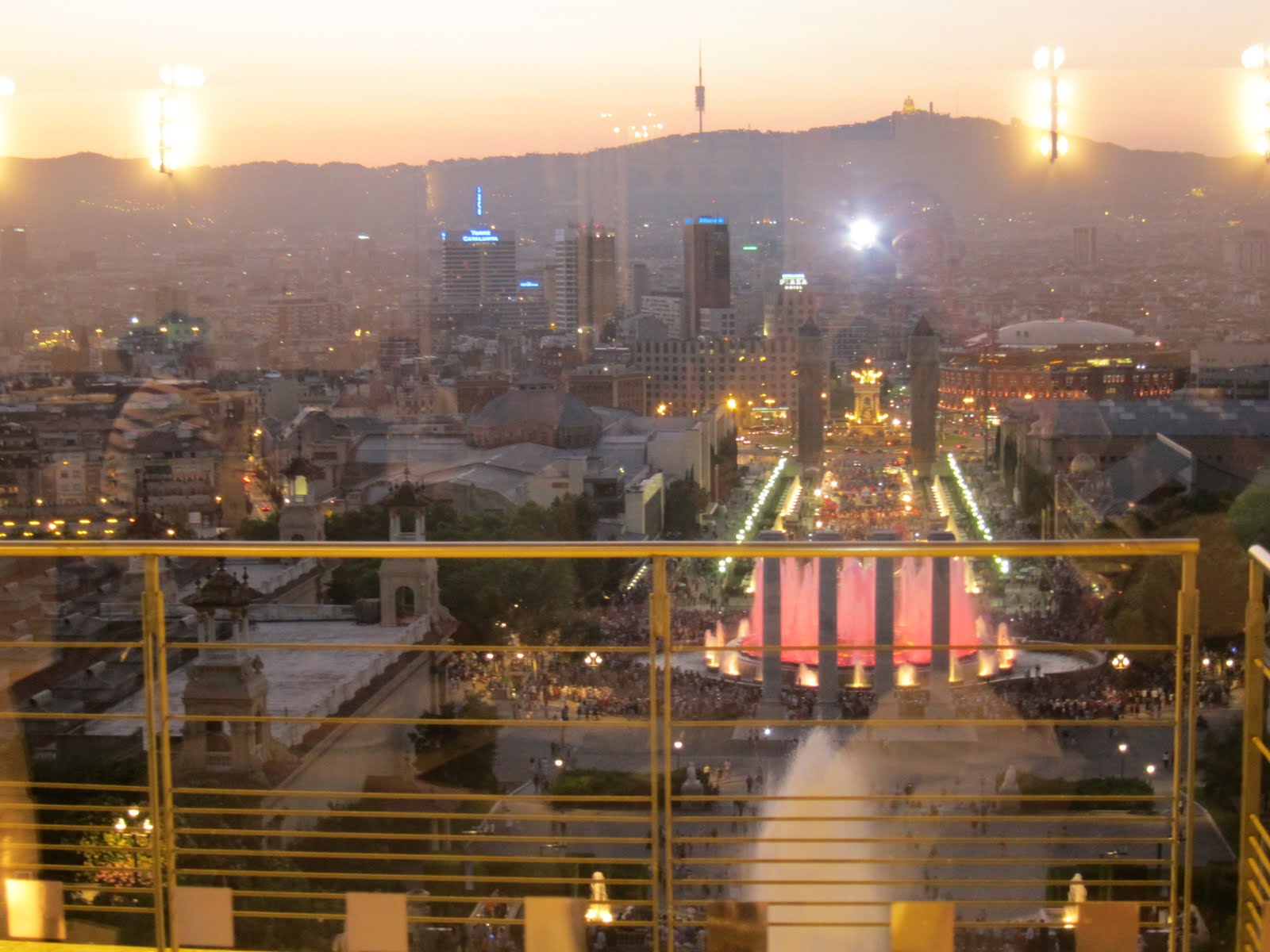
The same view with the "dancing fountains", seen beyond the pillars in the foreground. These fountains change their height, shape and pattern with a classical music background. As it gets dark they are colored with different lights. This view could be seen from the restaurant window.
View from the restaurant as the night began to close in on the evening.
The ceiling in the museum restaurant had an interesting feature with an angled mirror attached to catch a view of the dining room. The classical structure next to the modern mirror was quite a contrast.
The view of the ceiling on looking up from our table!
The last evening view from our table before walking down the steps beyond the fountain, where we observed a street concert / disco going on - with a twist.
This is the live concert going on beyond the "dancing fountain". Those are "soap suds" being sprayed out at the participants listening and dancing! As can be seen by the "stop" sign they have closed that part of the road for the event.
Yes "soap suds" - hope they have a change of clothes?
So with that we end our trip. The conference was good, and the R&R greatly appreciated.
The Med has that special feel, a different sense of life, of living more in the moment. whether on the Eastern or Western shores.
Yes it was another opportunity to put feet in the sand. Beyond the sand is the sea, and beyond that another horizon, a place to focus on to view more distant shores.
Stay tuned.