Friday, August 3, 2012

Tragedy & Serenity in the Red Sea

"Don't the large predators, like sharks, come out to feed at dusk and darkness?"
Good question, and one I was asked when planning on going on a boat night dive in the Red Sea.
In addition the skipper has a fear of jumping into black water at night, imaging all sorts of stuff that may be lurking and waiting. This trip in some ways was like a reality program where I consciously went out to face my fears. Maybe I was loosing my marbles, nothing new to my wife the Admiral, who decided to turn down this trip? Yes there are dangerous sharks in the Red Sea, a reputation it earned from mariners over the years.
Jumping into black water at night miles from shore? Yes I had to do a night dive before, 12 years ago as one of the requirements to obtain my PADI Advanced Open Water diving licence, but it was a dive from the shore, not into "black water" off a boat miles out to sea!

We were to leave the marina about four pm to head off into the Red Sea for about ten miles. This is usually the time that we are returning from our usual day dive trips. And of course it was hot, and humid, being just over 40 degrees C.

Waiting for the other divers to arrive (we arrived early) - very hot with the sunshine & humidity - wanting to get going to enjoy a sea breeze generated by the boat's motion.
My dive buddy (Des Williams, an Irishman) and I had already set up our dive gear............ now waiting.

However when we did get underway we experienced a rough passage heading into the waves generated by the afternoon sea breeze, and of course the building rolling waves - lots of spray, which in my mind was welcoming, particularly as the water was warm, but refreshing.

 The windows, as viewed from the inside of the cabin, also took a beating.

Our first dive, while still light, was to a shipwreck - from a mariner's point of view a tragedy, a steel ship hitting a coral reef. Unfortunately this part of the Red Sea has many maritme disasters due to the many coral reefs, many of them not properly charted. Fortunately our skipper knew the waters well, and did have a GPS for the reefs that were charted.
From a diver's point of view wrecks are always interesting sites to explore.


    And of course yours truly, as taken by my dive buddy.


After this wreck dive we are to head off to another reef to have dinner on board, while waiting out our "surface interval" (decompression time), and for the sun to set.


This poor soul preparing our dinner cannot eat or drink, despite the heat, until the sun goes down - it is now Ramadan, the Islamic Holy Month, where a muslim cannot eat or drink between sunrise and sunset, for a month.

After we eat we "chill" and wait, for the sun to go down, so we could jump into the "black water". Fortunately the breeze had abated and the waves settled.


Unfortunately my underwater camera did not have a flash attachment, so it was not possible to do justice to the night dive. This image (below) is deceptive, as although it was dark when we submerged, being a full moon there was actually enough light to see some detail, but no colors.

So what did I feel when eventually it was my turn to jump into the "black water"? What are our preconceived images that haunt our conscious and unconscious minds, and how does the actual event transpire when it does take place?
No, there were no sinister creatures from the depths, at least not this time.
The experience was in fact very serene, and surreal.
The moonlight could be seen to some degree penetrating to the depths (we went down to about 50 feet). When our lights were turned off, and our buoyancy adjusted to just "hang" over the vista, the forms and bubbles could be seen, and we just drifted in a surreal world. Very peaceful.
But would I ever skydive ........ No, there are limits!

.......................................


Friday, July 6, 2012

Stones and Imagination

"Are they not just a bunch of old stones?"
Some may say that. That's ok. Some people prefer beer, others wine.
I say that all one needs is a sense of imagination, and wonder. Things that sometimes are diminished to some extent as we move from childhood to adulthood.
And of course a sense of history, where we came from, what they have witnessed over the centuries, the challenges in building these "old stones", and appreciating that they still stand in some form after 1000 to 2000 years.
Yes we also have other "old" forms of art we appreciate, Da Vinci's Mona Lisa, Mozart's music, then of course the "old" architecture (including the "less old" Notre Dame or the Eiffel Tower in Paris), and the stories that they could tell, if they could. What evidence will the CN tower, or other buildings we erect today, have left behind in a similar time frame going forwards? Yes just "old stones" in some minds?
We need that sense of imagination & wonder when we stand in their presence, and just "be there", taking in the moment, and just imagine, and imagine some more. Then they come alive.
Jordan is a country full of these "old stones", and so the journey continues.

North of Amman, sitting on a mountain top, is a castle at Aljun.
It is one of the best preserved medieval fortified structures in Jordan, built about 1100 AD by the Arabs, and never conquered by the Crusaders in their quest to capture the Holy Land. But captured and partially destroyed subsequently by the invading Mongols (Ghengis Khan and his hordes on their way to Europe).
The castle sits on the mountain top in the middle of the picture.
In the foreground are many Olive trees, growing like weeds in this part of the world, as in many Mediterranean countries. Interestingly inside the castle with the thick stone walls it was quite cool, despite the heat outside in the sunshine - medieval air conditioning.


The above site was North of Amman - we were to set out going East, where the borders of Iraq, Syria, and Saudi Arabia were quite close. With the present ongoing military conflict in Syria, and knowing that some people were escaping the country through Jordan in this vicinity, as well as the continuing instability in Iraq, added a flair for the unanticipated. Fortunately all was peaceful.
We headed out to the area of the so called desert castles, some as fortifications, some as "vacation" spots of the rich from Damascus a thousand years ago, and one as possibly an ancient "inn" at some point.
In this area to be explored we were quite close to several "hot spot" borders as can be seen from these road signs at intersections we came across - our driver assured us he didn't want trouble either - comforting?!

The first "desert castle" was Qasr Al-Azrac, built originally by the Romans about 300 AD, then expanded by the Arabs during the wars with the Crusaders, and apparently a base for Lawrence of Arabia (a Brit) during the winter of 1917 during his role in supporting the Arab uprising against the remains of the Ottoman Empire. After the war ended Britain, France and Russia divided up this part of the Middle East to establish the present borders (Israel, Lebanon, Jordan, Syria, and Iraq) for better or for worse in light of the present politics of the region. The politics of Imperial Powers.


The next desert castle was Qusayr Amra, originally built by the caliph of Damascus about 700 AD as a place for "restoration and diversion" (or "cottage" in our world!). Its structure is an example of an early phase of Islamic art, as applied to architecture. This same caliph was also responsible for the building of the spectacular Great Mosque of Damascus. Although sitting in an arid desert landscape at present apparently there were lush surroundings at the time it was being used. Aside from having a "bath" (inspired by the Romans) the walls and ceilings were covered with a number of frescoes.


The last "desert castle" we visited was Qasr Al- Kharana. Originally a Roman building, subsequently rebuilt by the Arabs about 700 AD, believed to be built as a sumptuous residence for the caliph or maybe subsequently as an Inn for travellers moving between Damascus and the Holy Land.


Our final exploration of "old stones" in Jordan takes us back in time, two thousand years and the early Christian era again.
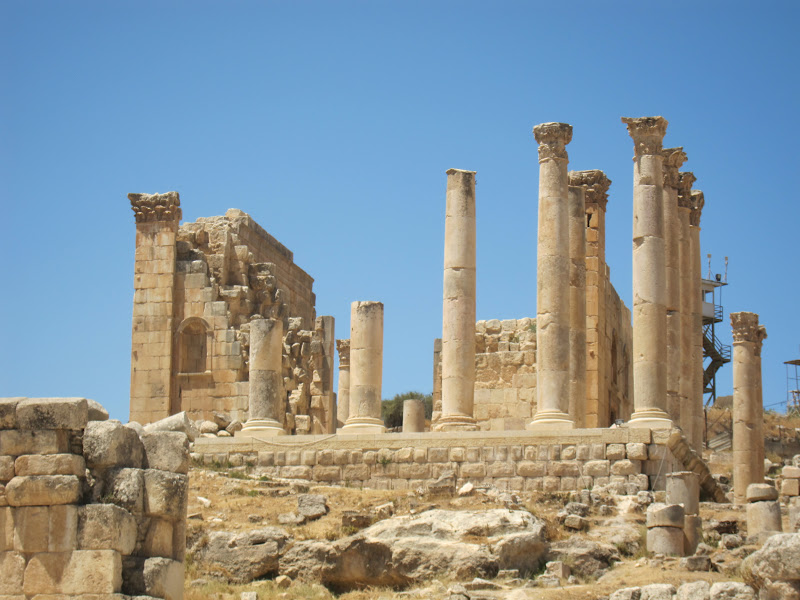
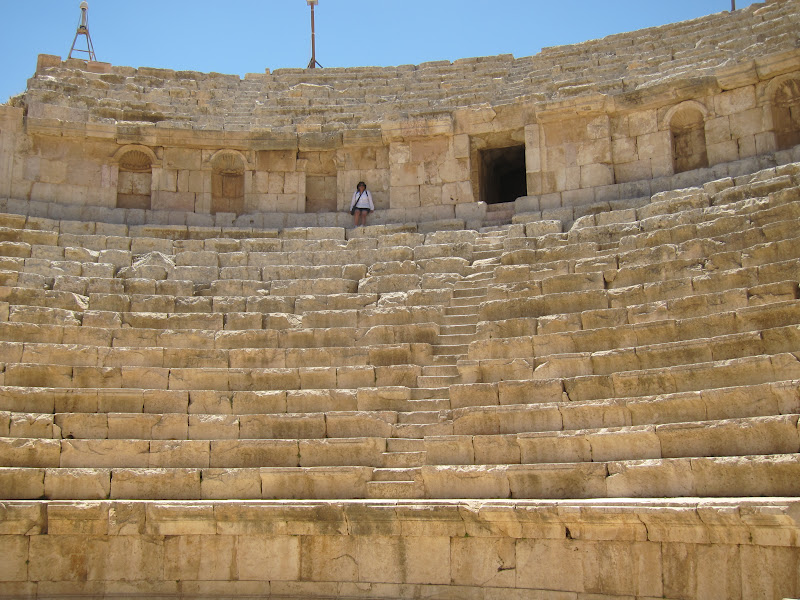
We are to visit Jerash, believed to be the largest and most well preserved site of Roman architecture in the world outside of Italy (although an argument could be made for the site at Ephesus in Turkey).
 It also has the longest series of columns still standing of any Roman city.
The images portray the size of this site from antiquity. It is still being excavated, noting archeologists on site during our visit. Unlike the Parthenon in Athens we were able to wander freely amongst the "stones", to get a true feeling of its expanse and scope at close range.


That takes us to the end of our "voyage through old stones".
But our imagination remains vivid, as an integral part of our life journey.
Indiana Jones could have been here.

......